
history of the open

The 153rd Open took place at Royal Portrush in July 2025. Golf’s oldest tournament has a prestigious history, so here’s a deep dive to prepare you for 2026's Open Championship.


The Origins of The Open

When talking about the history of the British Open, you’ve got to start at the beginning. The very first Open was held in 1860, meaning this event predates both the Masters Tournament and the PGA Tour by seventy years or so. Though the first Open took place in October, it is now always held in July.

The Open began at Prestwick Golf Club in Scotland, but it soon became tradition to hold this event at different ‘links’ golf courses around the UK. Links courses are usually coastal, offering interesting views, dunes, and terrain. Past Open venues include Carnoustie, Royal Liverpool and Muirfield.

This event has remained fairly consistent, but one interesting wrinkle in the history of the British Open is that the prize has changed over time. For the tournament’s first decade, a championship belt with a silver buckle was the iconic reward for the most skilled golfer. However, when Tom Morris Jr won three years in a row, this prize was reconsidered.

At first, the belt was temporarily replaced with a medal, which was awarded to now four-time winner Tom Morris Jr in 1872. Medals like this are still a big part of the event. For example, as of 1974, a silver medal is given to the leading amateur of The Open.

Winners still receive medals too, but this was no replacement for the championship belt. So, in 1873, they introduced the Claret Jug as the major prize of the event. This is the iconic symbol of The Open that we all know today.


Who Won the Last Open?

The last Open was won by Scottie Scheffler. This prestigious golfer won by a serious lead, and became one of the only golfers ever to win The Open whilst holding the number one spot in the world ranking. The only other golfer to achieve this was Tiger Woods.

Before this, the last Open Championship was won by Xander Schauffele in 2024. He secured his victory by just two shots, but showed clear skill in the final portion of the game by succeeding despite 20mph crosswinds on the back nine. This was just two months after Schauffele won the PGA Championship – 2024 was a big year for the American!


Why Is It No Longer Called ‘The British Open’?

Technically, The Open has never been officially called ‘The British Open’. However, many people refer to it that way to avoid confusion. The US Open (established in 1895) typically takes place the month before The Open, and it’s easy to get the two tournaments mixed up.

The US Open only has ‘US’ in its name because it came after the original Open Championship. This is similar to how many British shows end up with American spin-offs that just add ‘US’ to the name. The fact that it was adapted does not change the name of the original – so the British event is just called The Open.

According to The Open’s own website: The Open is the correct name for the Championship. It is also the most appropriate.”

Even though this may factually be the case, it is sometimes still necessary to use the term ‘British Open’ in order to be clear. As long as you remember that the true name is The Open, it does no harm to say British Open conversationally, just for clarity.


What Is the Prize for The Open?

As mentioned above, the prize was historically a belt, but now the winner of The Open gets to take home the Claret Jug to keep for the year. However, that’s not the only prize on offer.

There is also a considerable payment made to the winner. The actual amount tends to change year on year; there is usually a set “purse” for each event, and the winner is not the only one who gets to take home a cash prize. In both 2025 and 2024, the purse was $17 million, with winners Scottie Scheffler and Xander Schauffele each taking $3.1 million for their wins.

Of course, the real prize is that you get to keep coming back to play in The Open until you are 60, or for the next ten years (whichever is longer).


When Is The Open?

The Open is held every July. The next Open will be held from the 12th to the 26th of July 2026, at Royal Birkdale.

2025's event took place at the Royal Portrush Golf Club in County Antrim, Northern Ireland on 13th – 20th July 2025. Much of the event was broadcast live for viewers not able to attend in person. For people lucky enough to be there, the gates opened at 9am on the 13th.


Ready to Play Golf?

If learning about the history of The Open has you itching to pick up your golf bag, don’t forget to stock it with some high-quality golf balls! At gimmeballs, we have a great range of golf balls available at low prices. We even have most of the balls that were used by the pros at the last Open Championship.

Shop Golf Balls

LEARN MORE: What Golf Balls Do the Pros Use?

LEARN MORE: Who Will Be Playing in The Open?

Golfing in the rain

Golfing in the rain can be challenging, but with the right approach, it's still a fun and rewarding experience. The game can be just as enjoyable in wet conditions – but only if you do it right!

To make the most of your round, here are 12 smart things to do when golfing in the rain...

How often should you change golf balls?

You should change your golf ball very often - many professional golfers change their ball every hole or every few holes. Change your ball when you notice a change in performance.

Let’s say you get lucky and manage to go a full round of golf without losing your golf ball. And then, miracle of miracles, you get through another one. And another one…

If you’re good at keeping your golf balls like this then you’ll eventually have to ask yourself the question: should I change my golf ball?

We’re here to help. If you aren’t sure how often to switch an old golf ball for a new one, then join us as we discuss the most important factors of golf ball integrity. Do scuffs and dirt matter? Let’s find out.


Signs that you should change your golf ball

When trying to figure out if you should change your golf ball, a golf towel is your best friend. As a general rule of thumb, if any damage or dirt can be wiped away by a towel, then it shouldn’t cause you too much trouble. Small scuffs that can be mostly wiped away probably won’t impact your ball too badly.

You’ll probably want to swap out your golf ball if the ball’s surface is significantly damaged or particularly scratched. This isn’t always necessary – quickly test if the ball rolls as-expected when hit. If the scratch is causing the golf ball to lean in any particular direction, then it’s time to change it.

Inspect your golf balls whenever you get the chance to. As long as the ball isn’t badly misshapen or performing strangely, then you should be able to continue using it. The only real exception is professional or competitive games of golf. In these cases, you may wish to swap out your ball just in case - you wouldn't want any damage ruining your win!


Do balls perform worse the longer you use them?

In a theoretical scenario where your ball survives with no dents or scratches, can you keep using it forever? This really depends on the ball itself. Most modern golf balls have great durability, but golf balls that are constructed from cheaper or softer materials may not be able to last as long as premium balls.

Golf balls may also lose compression over time and can deteriorate due to different factors like heat or moisture. However, this is usually only a problem if you store golf balls incorrectly.

This is why pro golfers change their golf ball every hole, or every few holes. They can't afford the risk of failing a shot over a broken or damaged golf ball. However, swapping balls this often can seem expensive and wasteful for a beginner golfer. If you are confident in the durability of your golf ball then you can probably keep using it without any issue for a good while. If you can feel it getting worse as you play, then swap it out.


Is it time to change your golf ball?

Whether you want to change your golf ball every hole or not, you’re going to have to change it eventually. It’s best to keep a few high-quality spares in your bag just in case. At gimmeballs, we offer a range of great golf balls at low prices so you won’t have to worry as much about losing or damaging a couple of balls.

Shop Golf Balls

FURTHER READING: How Many Golf Balls Should I Carry in My Bag?

golf ball rollback

The golf ball rollback proposal announced in 2023 plans to restrict elite-level professional golfers from using a ball capable of travelling further than 317 yards at 127mph clubhead speed.

Read on to find out why R&A and the USGA are enforcing the rule, how it may affect the game and the latest rollback proposal updates from 2025.


golf gadgets for dad

If you’re looking for the ultimate golf gadget to gift your dad this Father’s Day then you’re in the right place! At gimmeballs, we stock the perfect piece of tech for dads that love golf and gadgets – the Shot Scope Pro X Rangefinder! In this blog we will explore what a Shot Scope Rangefinder is and why it makes an ideal present for your golf-loving dad this Father’s Day!


What Are The Softest Golf Balls?

Soft golf balls are often preferred by new players and those with slower swing speeds due to their forgiveness, increased spin and better feel around the greens. But what are the softest golf balls on the market? This blog will list some of our favourite soft-feel golf balls so that you can find the perfect ball to elevate your game!


1. Titleist 2024 Tour Soft

If you’re looking for a good all-rounder with an ultra-soft feel, Titleist’s Tour Soft is an excellent choice. With a compression score of 65 and an ultra-thin Fusablend® cover, the Tour Soft is perfect for golfers who prioritise softness without compromising control.

Despite its incredible softness, the Tour Soft still feels powerful and stable off the tee, travelling a fair distance down the fairway with a low spin. Its faster, larger core and refined dimple design deliver optimised ball flight and speed for longer distances, making this ball ideal for any golfer that’s after a soft feel and doesn’t want to break the bank.


2. Callaway Supersoft

One of the softest golf balls on the market, the Callaway Supersoft has a compression rating of 38, making it ideal for players with slower swing speeds who want to maximise distance. This ultra-soft feel combined with the hyperelastic SoftFast core results in a more efficient energy transfer at impact, leading to higher ball speeds and better launch with less spin.

Callaway’s unique hexagonal dimple arrangement also helps to reduce drag and increase lift to help players achieve better launch angles off the tee.


3. Wilson Duo Soft

The Wilson Duo Soft has an incredibly low compression score of just 35 and has been dubbed by some as the ‘world’s softest golf ball’. This low compression score undoubtably helps to boost distance off the tee for those with slower swing speeds and also makes this ball a good choice for golfers who struggle with excessive spin.

In addition to this, the Duo Soft features VelocitiCOR technology, that is designed to extract and amplify every ounce of power from a player’s swing, resulting in great distance and an exceptional feel with every shot.


4. Srixon 2025 UltiSoft

The Srixon UltiSoft is Srixon’s softest ball with a compression score of 42, however this does not mean it compromises on power or distance! Delivering all-around performance across the course, the UltiSoft provides an ideal mix of distance and control. Featuring a FastLayer core, the UltiSoft is softer in the centre and gets progressively firmer towards the outside, providing penetrating launch and excellent distance of the tee.

The soft, thin cover of these Srixon balls also helps to provide more greenside spin and a softer feel on all pitches, chips and putts.


If you’re looking for more soft golf ball suggestions, you can filter specifically for “Soft Feel” balls when browsing our collection. Click the button below to get started!

Shop Golf Balls

Callaway Chrome Soft vs Chrome Soft X: What’s the Difference?

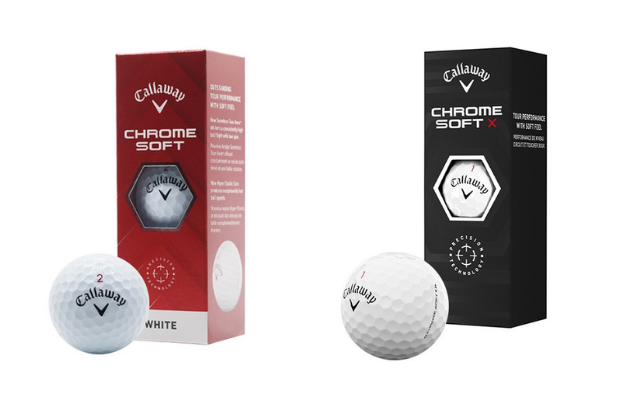
In this blog, we’ll be comparing two powerful Callaway golf balls: the Callaway Chrome Soft and the Callaway Chrome Soft X.

You might easily get these balls mixed up, given that they have similar names and both feature soft urethane covers. However, these two Callaway balls do have a few differences, and their unique features could have a noticeable impact on your game.


Callaway Chrome Soft Golf Balls

Considering adding Callaway Chrome Soft golf balls to your golf bag? These are ideal for golfers who want a tour-quality golf ball that offers unmatched control on the green. Let’s explore some of the features that make the Chrome Soft such a popular golf ball.

Callaway Chrome Soft: Key Features

Soft Feel: With its Tour Soft Urethane Cover and Hyper Fast Soft Core, this ball has a great feel that will appeal to golfers who prefer softer golf balls.

Low Long-Game Spin: Lower long-game spin can help you achieve better distances, so the Callaway Chrome Soft is a good choice for golfers who are struggling to get their ball to travel far.

High Short-Game Spin: For a lot of short-game spin, which can help you with launch height and ball control, this ball is a great choice.

Construction: This ball has a three-piece construction which contributes to the soft feel.

Buy Callaway Chrome Soft Golf Balls


Callaway Chrome Soft X Golf Balls

Callaway’s Chrome Soft X golf balls are the perfect choice for low-handicap golfers with fast swing speeds. If you want to maximise speed and distance off the tee, then consider switching to this ball, which boasts great driver speeds. The features of the Chrome Soft X are slightly different to the classic Chrome Soft ball.

Callaway Chrome Soft X: Key Features

Medium Feel: With a Hyper Elastic SoftFast Core, this ball is constructed with a soft/medium feel. The Callaway Chrome Soft X ball’s higher compression means it feels a little firmer than the standard Chrome Soft ball.

High Speed & Driver Launch: If you’re looking to improve your driver speed or get a higher launch on driver shots, then the Callaway Chrome Soft X could be a good choice for you.

Low/Mid Driver Spin: This ball has a low/mid driver spin to offer a better distance to golfers with high swing speeds.

Construction: A four-piece construction with a Hex Tour Aero Pattern contributes to the mid/high flight offered by this ball.

Buy Callaway Chrome Soft X Golf Balls


Differences Between Chrome Soft and Chrome Soft X

The key differences between these two golf balls are the construction and feel of the ball.

The Chrome Soft ball only has three layers, whereas the Chrome Soft X has four layers. This is one of the reasons why the Chrome Soft ball gives a luxurious soft feel, and the Chrome Soft X has a more medium feel, though both use a soft cover.

If you prefer a softer ball, the Chrome Soft is probably the better choice for you. On the other hand, if you have a faster swing speed you might prefer a firmer golf ball, meaning the Chrome Soft X could be a better choice.


Personalised Callaway Golf Balls

Your Callaway Chrome Soft and Callaway Chrome Soft X golf balls can be personalised when you order them from gimmeballs! We can print a design of your choice, like a photo or name, onto these golf balls for you.

Shop Callaway Chrome Soft   Shop Callaway Chrome Soft X

Golf rangefinder

A golf rangefinder is an innovative tool that measures the distance to targets on the golf course, such as hazards and flags.

In this blog, we will explore everything you need to know about rangefinders, including how they work, their special features and where you can find them for a great price – let’s dive in!


What Is a Rangefinder?

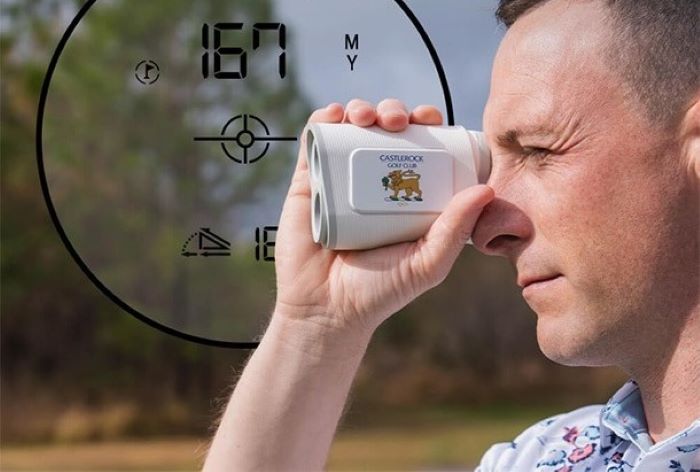
A rangefinder is a device that measures a distance to an object. Rangefinders can be used in many different fields—including hunting, surveying and photography—but they are especially popular among golf enthusiasts, who use them to measure the distance between themselves and the hole. This can help golfers to improve their accuracy, distance control and shot selection.


How Does a Rangefinder Work?

Golf rangefinders use laser technology to measure the distance between you and your target. This is done by shooting the laser directly at the target and measuring how long it takes for the beam to bounce off and return to the rangefinder.

Some rangefinders even have technology that can account for slope angle to provide adjusted yardage!


Shot Scope Pro X Laser Rangefinder

At gimmeballs, we stock two colours of the Shot Scope Pro X golf rangefinder: black and white. This state-of-the-art laser rangefinder has an extensive list of special features, including adaptive slope technology, rapid-fire detection and target-lock vibration. Plus, it is water resistant and comes with an anti-slip rubber grip, secure carry case and built-in ultra-strong magnet for easy attachment to your golf cart.

You can even personalise your Shot Scope rangefinder with an image, message or logo of your choice; simply upload your design on our website and we will handle the rest!

Stand out on the golf course, improve your game and get your brand noticed with a personalised rangefinder from gimmeballs - you will never misjudge a shot again with this unique addition to your golf bag!

Shop Custom Rangefinders